
Low-Trust and High-Trust societies
Will your 'developing' country ever be done developing and actually become developed?

People always want to classify the world into familiar categories. Many of these terms such as first-world and third-world, developed and developing countries are familiar in our popular discourse. Many of these labels are now way past their best-before dates. The categories first-world, second-world and third-world are relics from the Cold-War era. They were useful to distinguish between Western capitalist states, Soviet communist states and the non-aligned states. That world is long gone.
The Developed vs Developing countries nomenclature came up following WW2 when economists researching on why some of the world’s economies were a lot more advanced than others came up with the terms ‘developed’ for the former and ‘developing’ for the latter. The well-intentioned economists theorized that by studying the economic policies of the developed countries and pushing them onto the developing countries, the developing countries could develop to become like the developed ones. This spawned a whole branch of economics called development economics, taught and credentialed by the top American and British universities and preached all across the world by acolytes working for the World Bank, IMF, USAID and other alphabet-soup of institutions.
Almost 7 decades on, some of the previously developing countries like China, Taiwan, South Korea, Singapore, UAE are, if not more, as developed as the prior ‘developed’ leaders like the US, UK, Japan, France. Some like India, Vietnam, Saudi Arabia, Malaysia seem to be on a strong trajectory to get there in a couple more decades. Some like Argentina, South Africa, Russia that could’ve been called developed back then have now regressed to look more like the developing ones today. Many like Pakistan, Nigeria, Kenya, Mexico, Egypt that were in the ‘developing’ category in the past continue to be ‘developing’ today with no visible timeline as to when they would be done developing and become developed. The US President Trump may have lifted the veil further by condemning some of the prior-labelled developing countries as plain ‘shit-hole countries’1.
The current frameworks of first-world and third-world or developed and developing are no longer effective for understanding the present state of countries around the world. You may feel the need to have a better framework of understanding the world if you can find yourself relating to any of the following scenarios:
You’re a citizen of a ‘developing’ country and would like to have a better leading indicator of whether your country actually is on the path to being developed, or will it just continue muddling in the lower middle for decades to come or will it regress to become a shit-hole.
You’re a citizen of a developed country and are greatly concerned about the influx of immigrants coming from the populous ‘developing’ countries. You’re in the dilemma where your country needs productive workers from the populous countries because your country’s labor-force is shrinking yet you also don’t want the migrants eroding your cultural values.
In this two-part essay, I propose the distinction between high-trust and low-trust societies as a framework for understanding which societies/economies are likely to be on a long-term path to prosperity compared to others and how people can approach the topic of immigration with more nuance.
The game-theory basis of trust
Let’s start with a quick recap with one of the most popular concepts of game-theory and economics called the Prisoner’s Dilemma.
From Wikipedia, the description is as follows:
“Two members of a criminal gang are arrested and imprisoned. Each prisoner is in solitary confinement with no means of speaking to or exchanging messages with the other. The police admit they don’t have enough evidence to convict the pair on the principal charge. They plan to sentence both to a year in prison on a lesser charge. Simultaneously, the police offer each prisoner a bargain. If he testifies against his partner, he will go free while the partner will get three years in prison on the main charge. However,. If both prisoners testify against each other, both will be sentenced to two years in jail. The prisoners are given a little time to think this over, but in no case may either learn what the other has decided until he has irrevocably made his decision. Each is informed that the other prisoner is being offered the very same deal.”
The game can be represented as follows:
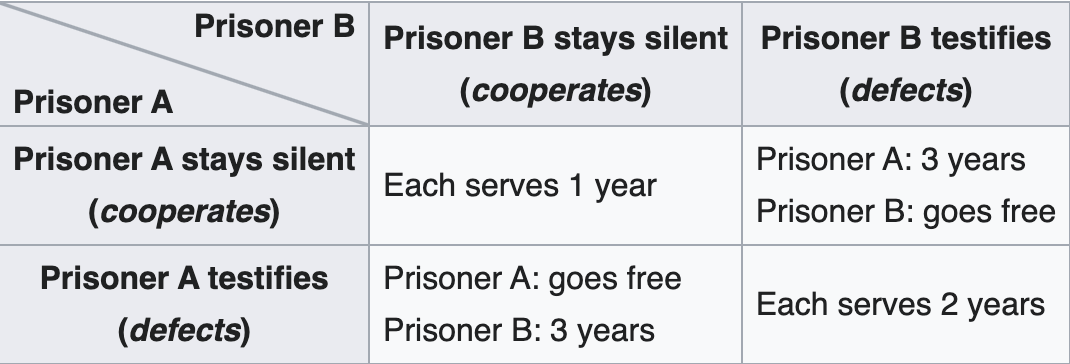
Each prisoner can get a higher reward by betraying (testifying against) the other. Knowing that the other prisoner is likely to testify against them to get the best outcome for themselves and leave them in the worst position; both prisoners end up testifying against each other. Mutual defection is the only strong Nash equilibrium in the game. By testifying, both prisoners end up worse off as compared to not testifying against each other.
The version of the game also assumes some additional factors, particularly that players have no loyalty to each other, and will have no opportunity for retribution or reward outside of the game. If both prisoners did have some loyalty to each other or expected some consequence of their choice, then they would be likely to trust each other to be nice (i.e. the other prisoner will not be the first to defect) and non-envious (i.e. the other prisoner will not strive to score more than me). Both prisoners may independently and simultaneously choose not to testify against each other and secure for themselves the best possible outcome.
Another version of the game, also assuming no loyalty and no outside consequences, is the iterated prisoner’s dilemma. Here the players are expected to play prisoner’s dilemma more than once in succession. They remember their opponent’s previous actions and are allowed to change their strategy accordingly. Players know that they will be rewarded or punished for their co-operation or defection respectively in the previous game. In the version of iterated prisoner’s dilemma where the game is expected to repeat infinitely, the dominant strategy for either player is to co-operate (not-testify) from the get-go. Hence both players cooperate and end-up with the best outcome.
Many real-life economic interactions map well to the prisoner’s dilemma concept. Say you take your car to the workshop to get its engine fixed. You have limited knowledge of the car’s mechanical components and rely on the mechanic to diagnose and fix the problem with the engine. The mechanic now has a choice, he can either co-operate / be honest or defect / try to ripoff. An honest mechanic will do an accurate diagnosis of the problem, suggest the appropriate solution, use genuine parts and reliably fix the engine. A dishonest mechanic may suggest an overblown and bloated solution, use low-quality parts and only apply a patch-work fix to the engine that may come undone soon after. If the mechanic tries to rip off the customer and can get away with it, the immediate monetary profit is much higher compared to doing an honest job. Conversely, the customer also has a choice, they can either co-operate by promptly paying the agreed-upon amount for the work done or defect by creating a fuss when paying the invoice or adding extra work to the scope without agreeing a higher price. With defection, the customer is trying to carve out a higher economic profit by lowering the cost they’d have to pay.
In low-trust societies, people generally expect counter-parties to defect in interactions as opposed to high-trust societies where the culture is to trust counter-parties to co-operate.
The economic costs of low-trust
Perhaps you can already visualize from the example above how both parties to an economic transaction are worse off in the low-trust interaction. As a customer you have to put your defenses up and try to supervise the mechanic as they do the work to make sure they’re not ripping you off. The opportunity cost of the time you spend in supervising the mechanic is time that could be spent more productively in your actual job or leisure. If the mechanic does succeed in getting away with a low-quality job, you’ll have to get your engine fixed again sooner than necessary. Knowing the mechanic is likely to get away with doing a low-quality job due to information asymmetry (the mechanic knows more about how to fix engines than you do), you’ll try to create a fuss at the time of payment in order to not end up overpaying. Both sides will remember this unpleasant experience. The next time your engine needs to be fixed (sooner than necessary) you’ll have to spend time and energy looking for a new workshop to try. The workshop would have to spend more on marketing to acquire a new customer to replace you.
These repetitive micro-frictions, nuisances, supervisory costs accumulate to impose significant additional costs at the macro-economic level. These costs are hard to quantify and may not necessarily show up in economic statistics; or show up in the wrong ways. Almost all bank branches, larger restaurants, shopping malls, retail supermarkets, jewelers, office-buildings in Pakistani cities have armed private security guards since the police can’t be trusted to deter criminals. The revenue earned by security companies and the salaries earned by the security guards may show up as positive numbers in the GDP of the country, but is that really adding to the national wealth? Would it not be better for the national economy if all the individuals employed for private security were instead working in an export-oriented industry that produced something more valuable?
In the global markets where firms have to compete for exports, assuming all things such as raw-material prices, energy costs, labour productivity, technology access being the same, a firm that has to bear the costs imposed by a low-trust society will always be outcompeted by a firm in a high-trust society that doesn’t have to bear those costs.
The principal-agent problem between business-owners and employees is much worse for firms in low-trust societies. The business owners can’t trust their employees to not place their private interest ahead of the interests of the firm. The purchasing managers can’t be trusted to acquire supplies for the firm at the best possible value and not receive kickbacks from vendors. The accountants can’t be trusted to handle funds carefully and not steal from the company funds. Firms can’t grow beyond what the owning-family can directly monitor and control.
We can use the example of India2 and China3 as the largest emerging4 economies for comparison. In both countries, micro, small and medium-sized enterprises (MSMEs) are major contributors to national GDP and employment. The distribution within the MSME category is as follows:
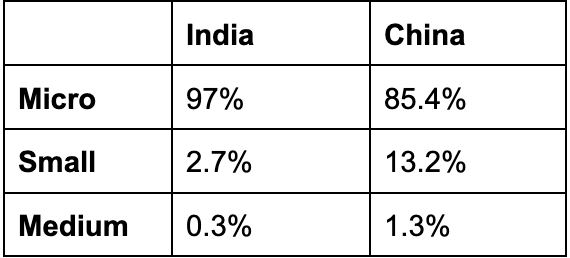
China has roughly 5x larger proportions of small and medium-sized firms within the MSME category as compared to India. There may be taxonomical differences in the data sources on Indian and Chinese firms, but the 5x difference is massive.
In India, medium-sized enterprises comprising only 0.3% of all MSMEs contribute nearly 40% of all MSME exports, indicating their significantly higher productivity as compared to the micro and small enterprises. Certainly there’s a large opportunity gap for the Indian economy due to a significantly higher proportion of MSMEs, relative to China, being in the micro-category and unable to achieve higher productivity and economies of scale. While there can be numerous factors to cause this difference, my hypothesis is that lower-societal trust in India, vis-à-vis China, is amongst the top ones.
Trust at different levels
Researchers regularly measure the level of generalized trust in a society by asking people the question “Generally speaking, would you say that most people can be trusted?“. The “could you leave the doors to your car or house unlocked while you’re away” kind of trust.
You’ll notice from the map below that countries in the highest tier tend to also be the most developed nations. You may also notice that there are several fairly-developed countries like France, Italy, South Korea, Turkey etc that don’t rank in the highest tiers of generalized trust.
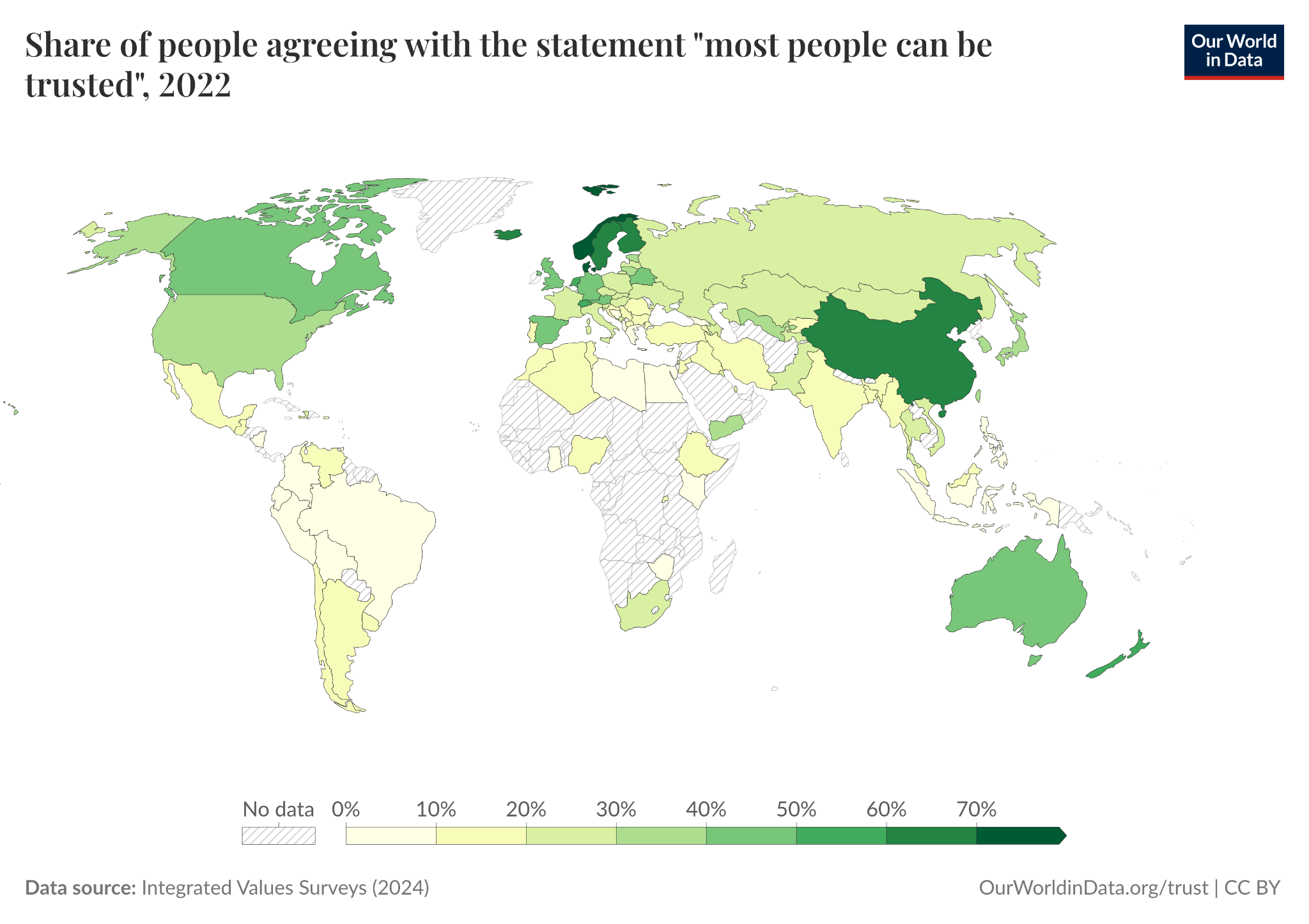
Particularized trust within tight in-group circles and institutional state trust can compensate for the lack of generalized trust.
In Pakistan and India, people generally tend to have a high degree of trust within the same familial / tribal / ethnic and sectarian community circle instead of a general trust in strangers. Certain small communities such as the Memons, Ismailis, Parsis, Bohras, Afridis, Gujratis, Marwaris own and run a disproportionately large share of large enterprises in their countries. The top-management tier of the largest Italian, French and Korean conglomerates tend to be dominated by people of the same families. Community / familial ties often hold stronger value than legal contracts for members within the same group.
People who aren’t sufficiently motivated by ethical/civic/religious virtues to co-operate/not-defect in economic interactions, may still co-operate if they sufficiently fear state punishment for defection. If the state and the legal system can be trusted to reliably enact and implement policies, protect property rights, uphold consumer protections, enforce contracts, punish defections and arbitrate disputes in a fair manner, then this can compensate for the lack of generalized trust between strangers. The Eastern European countries of Poland, Romania, Slovakia, Czech Republic also rank lower on the generalized trust scores, yet these nations achieved significant economic success after joining the European Union. Joining the EU forced their state institutions to end arbitrariness and be constrained within the supranational rules-based EU framework.
Conclusion / TL;DR
Any significantly large and complex commercial, military or political undertaking requires a vast number of people to organize themselves towards a shared purpose. Members of the organization need to trust that their fellow members are not placing conflicting private interests ahead of the interests of the organization.
High-trust societies or societies with sufficiently large trust networks and effective state institutions can re-develop advanced economies even after having all their physical infrastructure blown to smithereens see: Japan, Germany, Vietnam. If you’re a citizen of a ‘developing’ country with sufficient societal trust to organize people towards complex endeavors, chances are that your country can get on an accelerated growth trajectory to developed status by focusing on certain niche areas of competitive advantage like Taiwan did with semiconductors or Bangladesh is trying with textiles.
Not every society with low-levels of generalized trust has sufficiently large particularized trust networks or reliable state institutions to enable cooperation amongst a large number of people. State institutions after all are also made up of large numbers of the same people that wouldn’t trust each other outside of the institution.
If you’re a citizen of a low-trust developing country where people don’t trust others outside of the tiny circle of their nuclear family and don’t trust the state to uphold the law and protect their rights, then I’m afraid your country is likely NGMI (not-gonna-make-it) to be a developed country. Even in the scenario of an unexpected natural resource bounty such as a large mineral discovery, the wider economy is likely to suffer from a resource-curse and not reach a level of human development as seen in the developed countries.
In the next part of this essay, we look at some of the social aspects of living in a low-trust society, what happens when people from a low-trust society migrate to a high-trust society and how people living in the developed countries can take a more nuanced view on migration.
https://edition.cnn.com/2025/12/10/politics/donald-trump-shithole-countries-phrase
https://www.pib.gov.in/PressReleasePage.aspx?PRID=2131261®=3&lang=2
https://app.www.gov.cn/govdata/gov/201912/19/452158/article.html
I confess that calling China an emerging economy is probably not right anymore circa 2026.
Great piece… many decades ago (yes, I am that old) I read Francis Fukuyama’s “Trust”… your piece just reminded me of that.
eagerly looking forward to the next essay since i have been thinking about it a lot. this was one of the first things that struck me when i moved to the states. and NGMI -- absolutely. without trust there can be no growth in the economy.