
Sources of personal leverage
Accelerate your impact by finding and working on areas of high leverage

Most people would agree with the statement that they want to “maximize the impact” of the work they do. Those who do not seek to be “impact maximalists” yet are still ambitious, may want to retain their current levels at half the effort or be working 20 hours a week as opposed to the standard 40 hours. This boils down to the question of how individuals can increase their output-per-hour.
The short-answer is leverage. Archimedes referred to it when he said “Give me a place to stand, and a lever long enough, and I will move the world.” Building your personal leverage leads to an increase in your output-per-hour work which is likely to lead to an increase in your hourly compensation. The more value you give, the more you can take for yourself.
Nonetheless leverage is a vague, umbrella term that encompasses many different areas. This one word by itself isn’t useful to you, so let’s unpack it further.
Rather than this being a general post talking about leverage, here I’ll narrate from my own personal experiences and leave you to take what resonates with you.
Building better systems
In early-2017, as my first job after university, I joined the local city ops team of a ride-hailing startup that had just launched in Lahore a year back. I was recruited at the entry-level associate position and was told by the city’s General Manager to set-up the city’s supply quality function from scratch.
No one else in the city office knew how to set up a proper supply quality function because it wasn’t needed until the city’s ride-hailing operation reached a certain scale; which Lahore was just beginning to reach. I was told to look at what other cities were doing and copy from them.
The supply quality function was responsible for ensuring that drivers provided an adequate level of customer service to riders utilizing the ride-hailing service. This involved making sure new drivers were adequately trained during on-boarding and monitoring daily operations for any driver-quality complaints and taking the necessary corrective action.
This was particularly high-stakes for the company. Customers in a relatively conservative country like Pakistan expected a really high-level of quality of service in order to be convinced to ride in a private car with a stranger. For the majority of drivers, it was their first time ever in a service-sector job directly interacting with a customer, or living in a metropolitan city. Many drivers had a relatively poorer understanding of the city’s routes and traffic norms. Any untoward incident between a driver and the rider had the potential for massive social-media outlash against the company, and an exceptionally serious incident like a sexual harassment case, could’ve made the government force the company to shut down all operations.
The workflow for the supply quality function being practiced at that time in other cities was approximately like this:
Customer makes a complaint or leaves a bad rating via the app -> The customer support team apologizes to the customer and offers some recompense and then forwards the ticket to the supply quality team -> The supply quality team then takes appropriate action against the driver based on an incident response matrix.
We adopted this workflow and it began to fail for us within a month. In this linear workflow, an ops assistant on the team could process at most 80 tickets a day. The number of daily trips in the city was growing exponentially with 30% m/m growth. At roughly consistent complaint rates, the number of supply quality tickets followed a similar exponential growth trend. The team couldn’t keep up and there was an ever-growing backlog of unprocessed tickets. We hired 2-3 new members for the team and still couldn’t keep up. Adding more bodies to the problem wasn’t an acceptable or ‘scalable’ solution. We needed to come up with something different.
We realized that we needed to attack the causes of the problems rather than just deal with the symptoms or after-effects.
Each type of complaint didn’t need to be handled in the same way. Complaints like a dirty car or the AC not being on could be a one-off and should only be acted upon if it was a consistent pattern for the driver. A first-time behavior complaint could be dealt with a warning, however a serious complaint such as harassment or theft needed urgent escalation and action.
This needed a system to automatically fetch complaints as soon as they landed, categorize them based on the text contained within, compile them, action them as per a defined rubric and where needed escalate individual cases to us. This however was a project far, far down on the roadmap for the company’s centralized product, data and engineering teams to support. As a local city team amongst dozens of other cities, we were on our own.
Thanks to a senior manager, I was able to get direct access to an analytics database. I had to learn SQL from scratch and then build the queries to get structured data in a consistent format. Then I built a super-basic keyword based complaint categorizer using Google sheets, Using various formulas and pivot tables, any complaint requiring urgent action would immediately pop-out, drivers consistently receiving a complaint of the same type would be escalated and, using the pareto principle, the minority of drivers causing a majority of complaints would be highlighted for corrective action.
The workflow now became that every few hours we would run a query that would pull out the recent-most complaint data, we’d copy it over to our processing spreadsheet and be told of where to act. From being constantly behind on quality incidents happening in the city, we were now on top of how drivers were performing and could take targeted action where needed.
This may feel like ancient history to people looking to “automate workflows with AI using tools like Zapier and n8n” but remember that this is the medieval era of 2017.
The impact
At a macro level, this was how things changed.
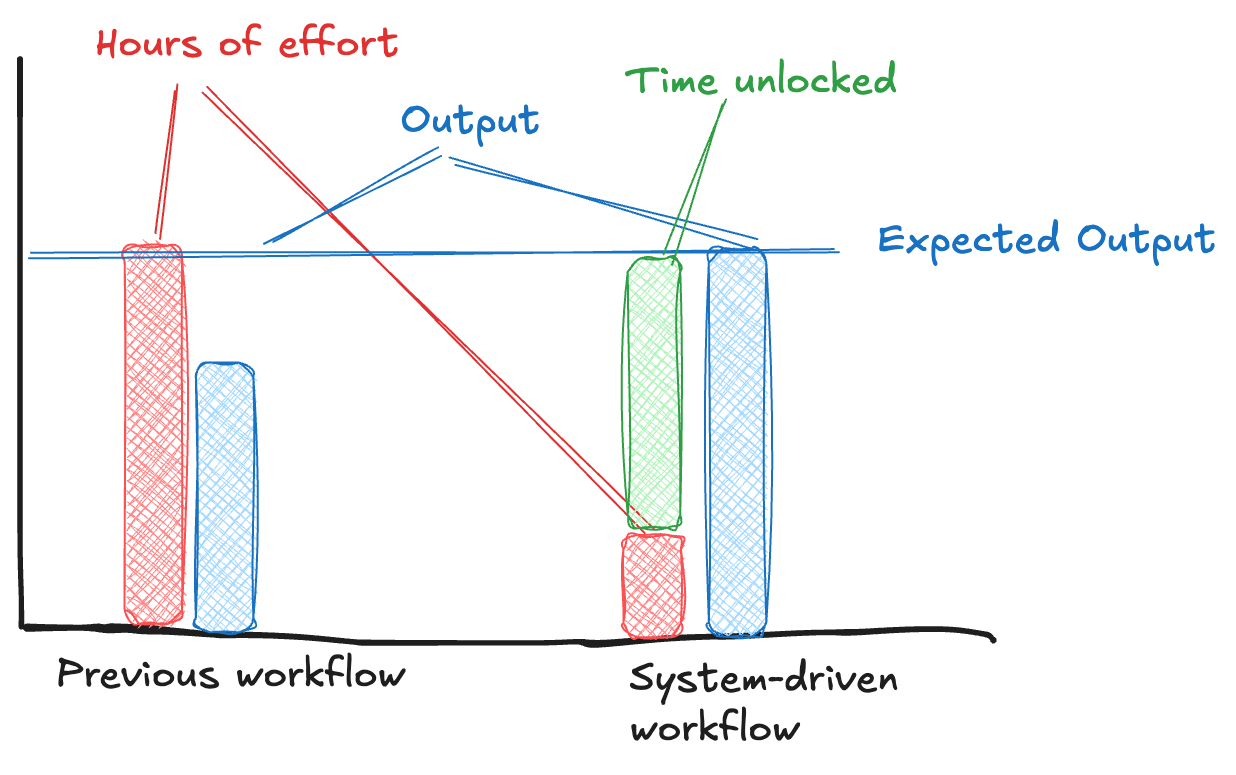
In the previous workflow, we were putting our maximum hours of effort but continuously lagging from what was expected despite recruiting more and more people on the team. The small minority of bad-faith drivers continued to run amok and spoil the experience of our customer whilst we struggled to find those needles in the haystack.
Once we transitioned over to the new system, we had full coverage over any untoward incident and could respond to serious incidents even before the customer-support teams could process the complaint. What used to take over a 100% of my time dropped to about 25% of my bandwidth. From a performance evaluation perspective, from struggling to meet expectations despite putting in my full effort, I was able to meet the expectation of my role with only 25% of effort. I now had 75% of my bandwidth or about 6 hours a day to do other things.
There is a risk to this approach worth mentioning
This is how my work looked like when we were building out the new system on the side.
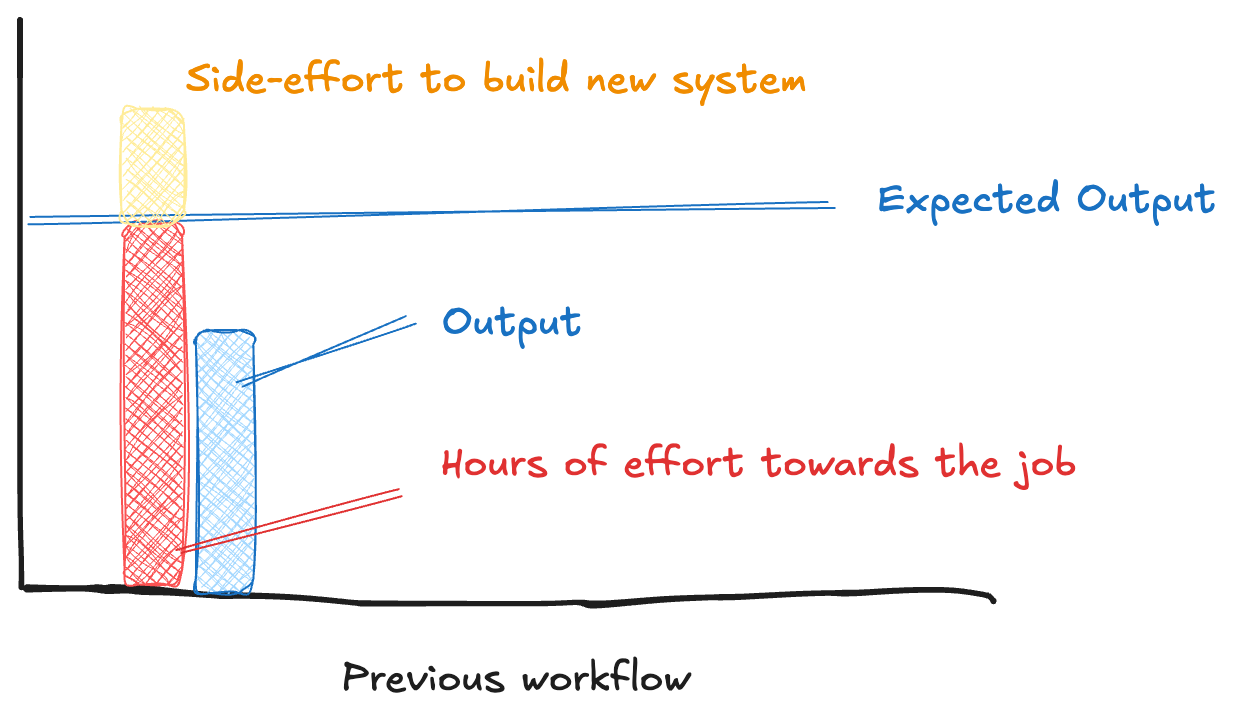
We were putting 100% of our regular bandwidth towards running operations under the old workflow and trying to keep up in vain. All effort towards building out the new system was beyond the regular 9 to 5; working late in the evenings or during the weekend.
Early in the career I didn’t understand the concept of upward communication, and my manager was frustrated as to why we were continuing to fall behind on expectations of solving the supply quality issue. I wasn’t able to articulate and communicate in advance of the new workflow being operationalized of how it would help us achieve better performance at scale. Soon my manager got frustrated by not seeing incremental progress being made and placed me on the PIP (performance-improvement program), as one procedural step before having get rid of me.
Fortunately we made it through just in time, the new workflow more than exceeded our expectations and it was all rosy, but looking back I can empathize how someone else in a similar situation may just abandon whatever they were up to on the side and do just what their manager expected of them.
The biggest leverage point
By re-architecting the whole workflow and automating many parts of it, we reached a level where the aggregate supply quality KPIs were at a level that was “healthy” for a city and we also were able to sustain that level as volumes grow by 50% every quarter. The healthy level was like meeting expectations, good enough for our customers but not delightful nor exceptional.
I got to the exceptional level through a highly non-linear path, significantly helped by luck, which showed me an even bigger leverage point. Here’s that story.
To build the new system, I got direct access to an analytics database and learnt SQL to be able to get and use data. Once the new system was built and I had the extra 6 hours a day, I kept poking around inside the database to see what else was there. I got a sense of the company’s data model, where specific information was stored and in what manner, what changed when a booking was made, cancelled, completed, where was all the pricing information stored etc. I reverse engineered the backend logic just by staring inside the database for several weeks.
Just for fun and practice, I started building more customized dashboards and reports which were a lot more detailed than the standardized ones made by the central business-intelligence teams. I went up to other teams/individuals with these and convinced them to do more experiments whose results we’d then see on my dashboards, like executing a promotional marketing campaign with the local marketing team and seeing how many customers signed up with an event-based promo code, or from a particular location, how many booking they took after the event and so on. I spent a lot of time with the team responsible for supply performance whose job was to make sure that the available drivers spent more hours on our platform, were available during peak-demand periods whilst keeping the driver subsidy budget under control. I was able to build a deeper relationship with the people heading these functions by just giving them what could be useful to them with nothing overtly expected in return.
From my relationship with the supply performance manager, I learnt at the right time that he had been given the objective to reduce the driver-subsidy expenditure by restructuring the driver bonus plan. I successfully convinced him that they add the driver’s supply quality rating as an additional qualification criteria for the weekly bonus, making the overall plan tighter leading to lower qualifications and lower aggregate bonus payout.
Almost immediately after the new bonus structure was rolled out, the aggregate supply quality KPIs, which I was directly responsible for, shot up to “exceptional” levels. At those levels, we also heard back from our friends and family that our drivers were well-trained and respectful. We hadn’t received such feedback before. Previously, there was only punishment for bad behavior. Now there was a reward tied to good behavior. The sudden jump to exceptional levels of quality demonstrated to us the power of incentives as a source of leverage.
My output-to-effort was now as follows:
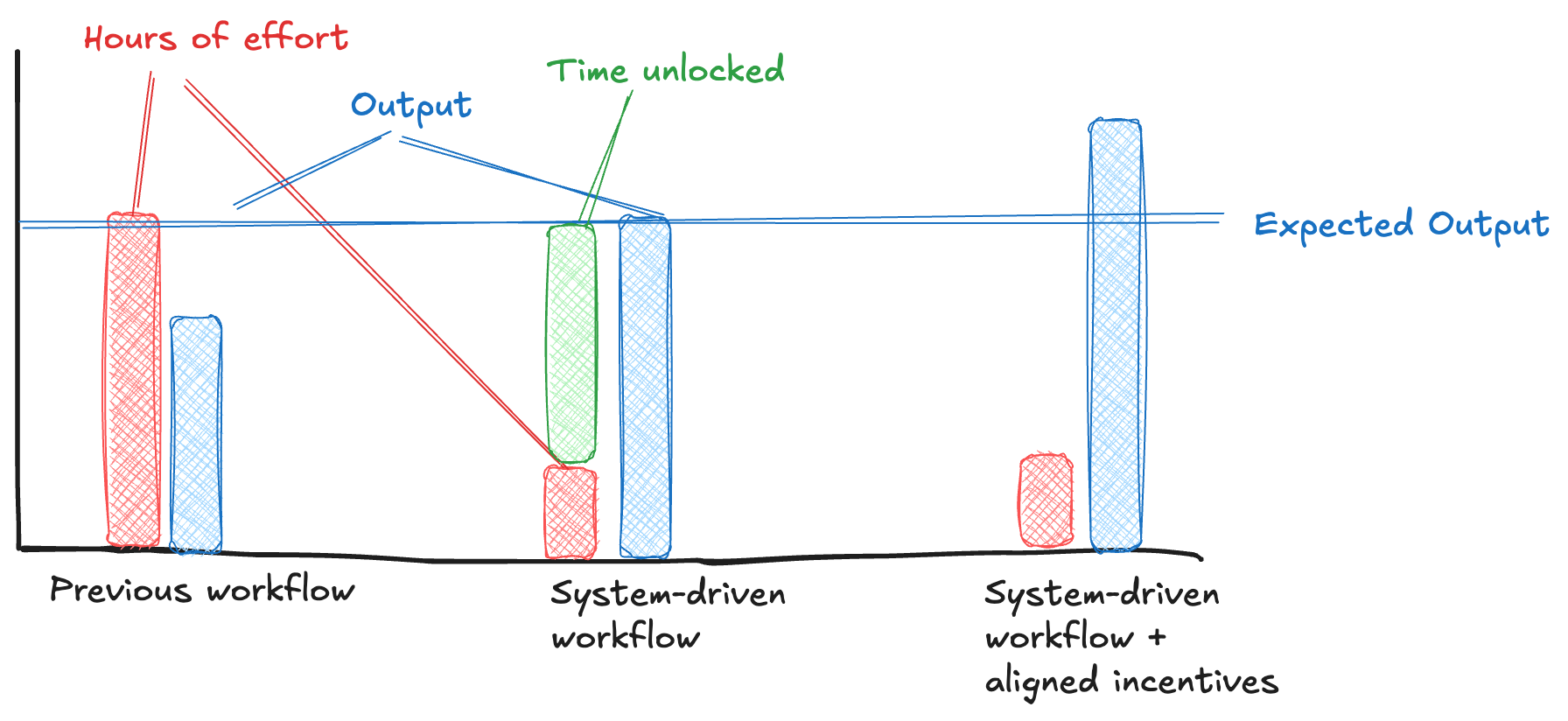
Whilst still only 25% of my efforts were going directly to the supply quality function, I was now exceeding expectations.
A lesson to draw from this is increasing your surface area of luck. I do believe that I got lucky that the supply performance manager got the objective to restructure the bonus structure at just the right time while I was around. However, I was prepared to meet that luck since I had inadvertently invested in building that direct relationship with other manager by building dashboards for him, which I was only able to do since I had learnt SQL and had some slack after automating many parts of my own job.
I consider myself lucky that I was able to learn the concept of leverage in my first year of full-time work. By working on these areas of high leverage, I achieved my fastest year of career growth which resulted in me transitioning from a city-ops role in one of the hundred cities to managing regional pricing and market intelligence from the corporate HQ. The general principle holds that you add more value or create more impact by increasingly leveraging your efforts, that value eventually does get recognized and you get rewarded in the form bonuses, promotions or other means.
Naval Ravikant, silicon valley’s eminent philosopher, neatly categorized sources of leverage into four categories: Capital, Labour, Media and Tech.
Capital and Labour need permission. If you’re working in a company, you need people higher up in the corporate hierarchy to give you permission to increase headcount or budget allocation. Even if you own the company, you need to convince investors to give you capital and talent to come work at your company.
Media and Tech are permission-less now. Social media has made Media more accessible by orders of magnitude. Anyone can go and build a following on Facebook, Instagram, X, LinkedIn or SubStack. A person with a larger number of followers can sell their products or ideas more widely compared to a person with a lower following, by exerting the same amount of marginal effort. Same with Tech where now you don't even need prior computer science knowledge or coding skills to outsource work to silicon chips that otherwise would require your time and brain cells.
All that’s needed, after recognizing these leverage points, is a deep desire to charge ahead and change your circumstances to do more with less.
Recommended reading: Leverage Points: Places to Intervene in a System
Love how you've so clearly explained "leverage". TBH, I've struggled with understanding this term well (even though I've been throwing it around as jargon), but your article made it so clear and easy. Thank you for sharing this, Ali! :)
Enjoyed reading this. Reminded me of how I learned SQL on the go as well and a whole bunch of other relatable experiences